Sunday, November 27, 2016
Readings
Here is the link for the article I'd like to talk about in Monday's class.
In the article, it simply described the marriage of Chinese women in modern days and the reason why it happens like that.

Wednesday, November 23, 2016


Tuesday, November 22, 2016
fibonacci mandala

a detail of Devon's "mandala," Tuesday 9:00am, 301 Cabot Gallery.
from the Leftovers thesis exhibition
Ricky Molander, Charlie Morse, Devon Unwin, Tori Cossette, LiAnn Natter and Ryan Kumicz
28 November – 2 December 2016
Monday, November 21, 2016
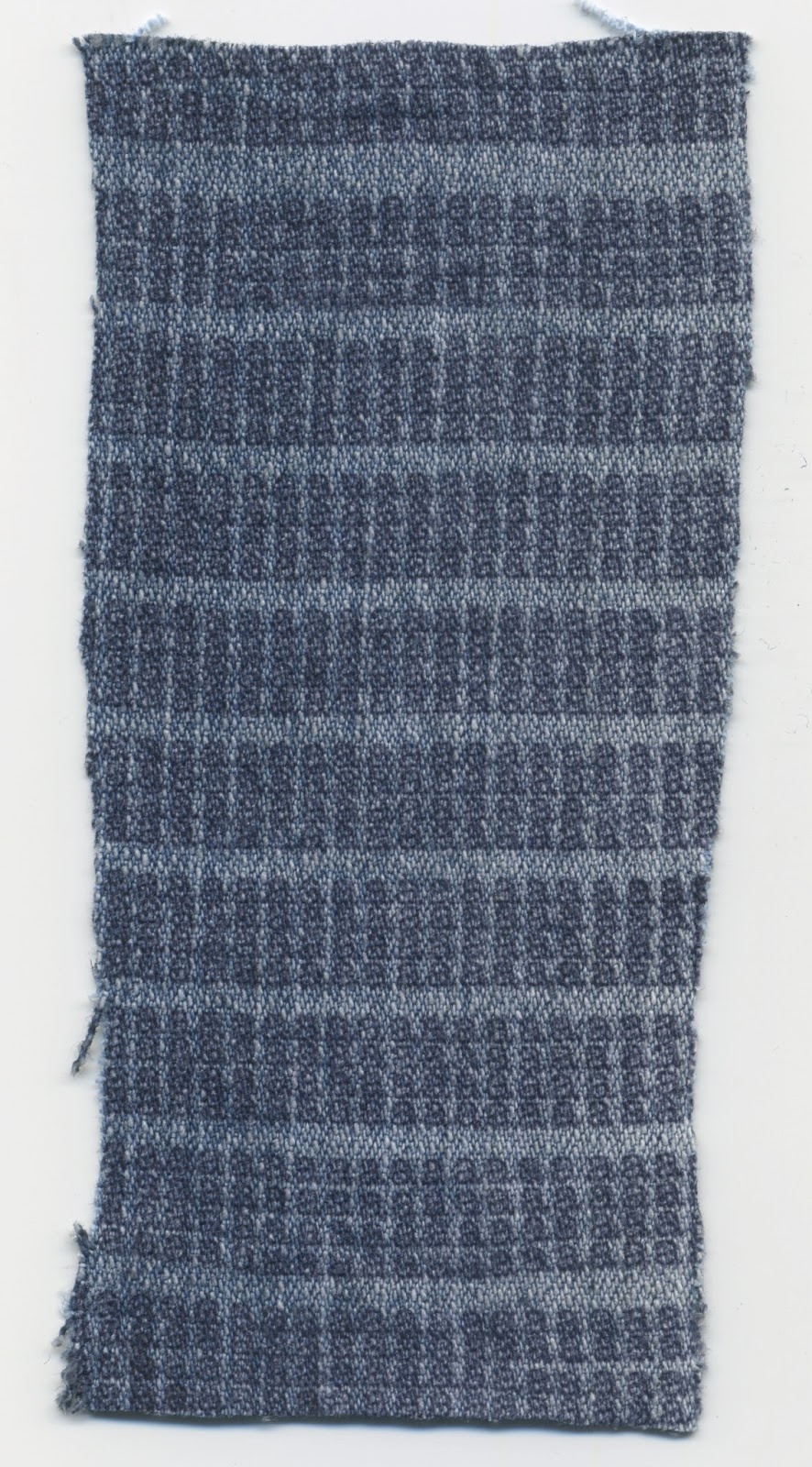
new experiments


I wanted to explore different materials to type on so I decided to type on denim jeans and see what effect I could get.

panel reviews, Tues and Wednesday evenings, 29 and 30 November
Tuesday 29 November
6:30 Devon
7:00 Elise
7:30 Katie
8:00 Ziyi
8:30 Li Yun
reviewers : John Colan, Jesse Kahn, John McVey, Sarah Trahan
Wednesday 30 November
6:00 Taylor *
6:30 Chase
7:00 Britney
7:30 Lauren
8:00 Adela
8:30 Alexandra
reviewers : John Colan, Bill Hanscom (for Taylor only), Jesse Kahn, John McVey, Brian Savignano
the thing
Showing an example of the formatting and structure of the Newspeak portion of the adjectives. This is just 4 pages of what "the thing" for blue looks like. The word blue was used 24 times through out the novel, so I have all 24 sentences in the book which used the word blue. Goal is to have this book printed by the time we meet next class.


Thursday, November 17, 2016
Readings - Collage and Family Stories
Here are a few things for my readings:
These are conclusions from two psychology articles about family narratives, and two handouts from Tim Harney about collage/art in general. Don't worry about the full articles, these conclusions are enough, I don't want to take them super seriously but there are some points that I want to talk about.


"In this article, I described research demonstrating the prevalence and importance of family narratives. Stories we create with others through socially shared interpretations and evaluations of our personal past constitute our very being. This process begins early in development and continues throughout the life span. Memory of our past is not relegated to a dusty archive, but lives in the moment, in a constantly evolving dialectic between our self and others in the telling and retelling of who we are through what we remember. Research has shown how this process is modulated by individual, gendered and cultural models of self expressed in everyday family reminiscing. Importantly, just as our individual stories are shaped by cultural and historical models of selves and lives, individuals come to shape their culture and their historical moment by the stories they tell. Autobiographical narratives are not just about the individual, but are very much about the historical time and place within which lives are lived and interpreted. Clearly, as Smith (2004) notes in the quote that began this article: ‘A life without stories is no life at all.’ "
"As we have reviewed here, co-constructed narratives of personal and familial experiences are critical in the construction of self and the understanding that self is continuous in time. Moreover, language is the decisive tool in this process; without language, a sense of self through time would not be possible. Whereas infants clearly recall specific episodes (seeBauerr, 2002, for a review), it is only as children begin to share their memories with others through language that children come to the realization that their memories are representations and that they have a unique perspective on their past. outside of language, past events can be referred to, but individuals’ memories of those events, and especially their evaluations of those events, cannot be compared. The process of reminiscing, of conversationally sharing experienced events as well as the associated thoughts and emotions, is essential for the development of children’s understanding that their memories are uniquely their own, and it is this understanding that allows for the idea that the self, as an experiencing entity, is continuous in time. Without a subjective perspective, the notion that I am the same I as yesterday would be dif cult to construct.
When we turn to the intergenerational self, the role of language is even clearer. There is simply no possible access to the experiences of others outside of language. There is no possible way that a child can know about his or her mother’s childhood except through the stories the mother tells to the child. as the protagonist of Anita Diamont’s novel, The Red Tent, states when asked how she would tell her life story, “I would have begun with the story of the generation that raised me, which is the only place to begin. If you want to understand any woman you must first ask her about her mother and then listen carefully. ... The more a daughter knows the details of her mother’s life ... the stronger the daughter” (1997, p. 2).
What is remarkable is that these family stories become part of our own personal self-definition. how we take on the stories of others, and use them to create our own sense of self, is an astonishing phenomenon still in need of a great deal of explication. Children who know their family history, who have shared in these stories, develop a sense of self embedded in a larger familial and intergenerational context, and this sense of self provides strength and security. It is through language that we share our memories with others, and it is through language that we understand that we are a unique entity, a self with a personal and familial history through time. "
Subscribe to:
Posts (Atom)